
The Living Terminal: Decoding the Anatomy of Luck in Real-Time
Editor: Welcome back, Mr. Bold. In our last session, we touched upon the “Vortex Machine”. However, things have moved much faster than anticipated. Due to overwhelming demand from our readers and active users, you’ve officially launched the live analysis engine at vortex.axisbrief.com. It seems the “hood” is already open for everyone to see.
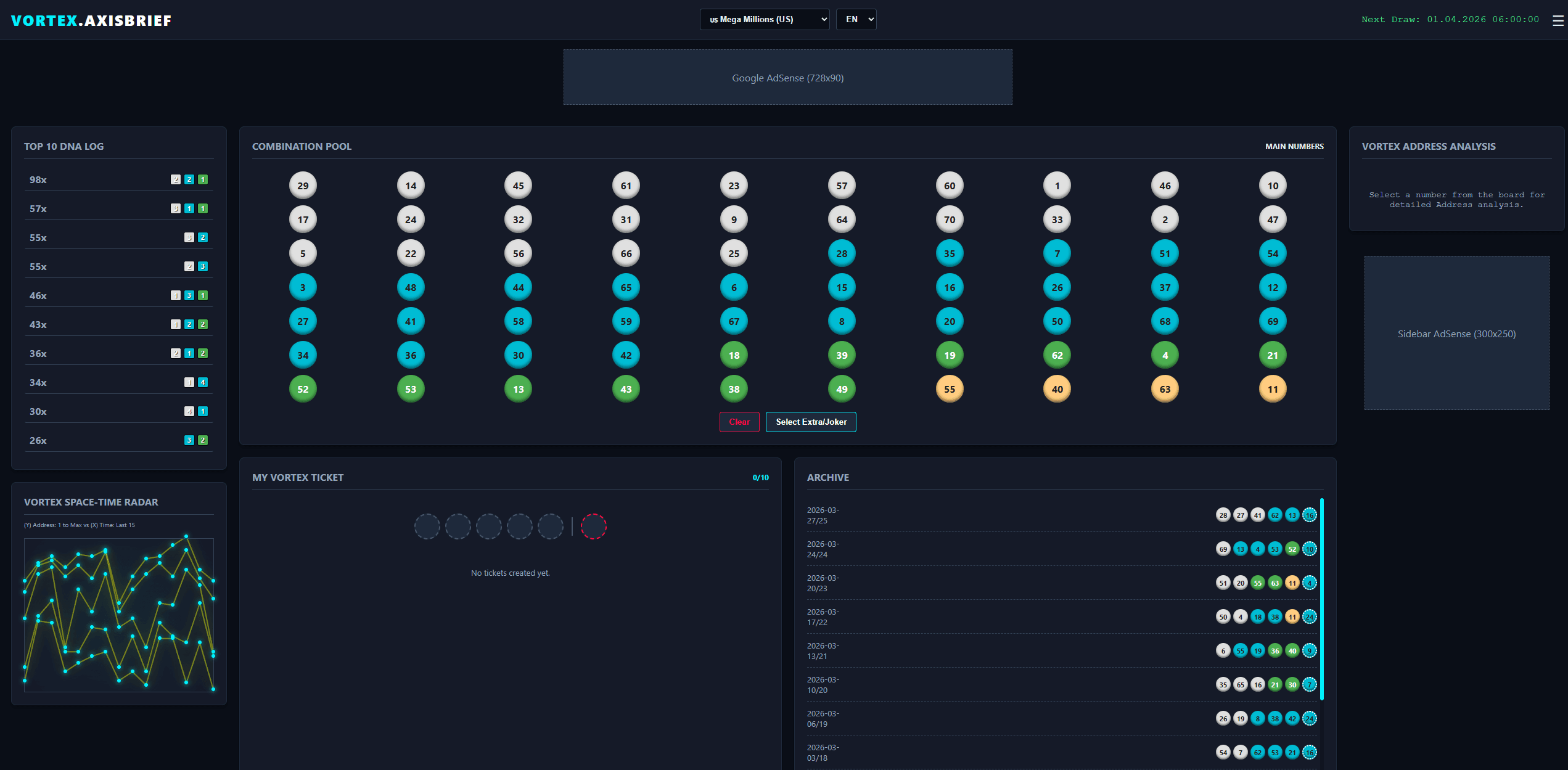
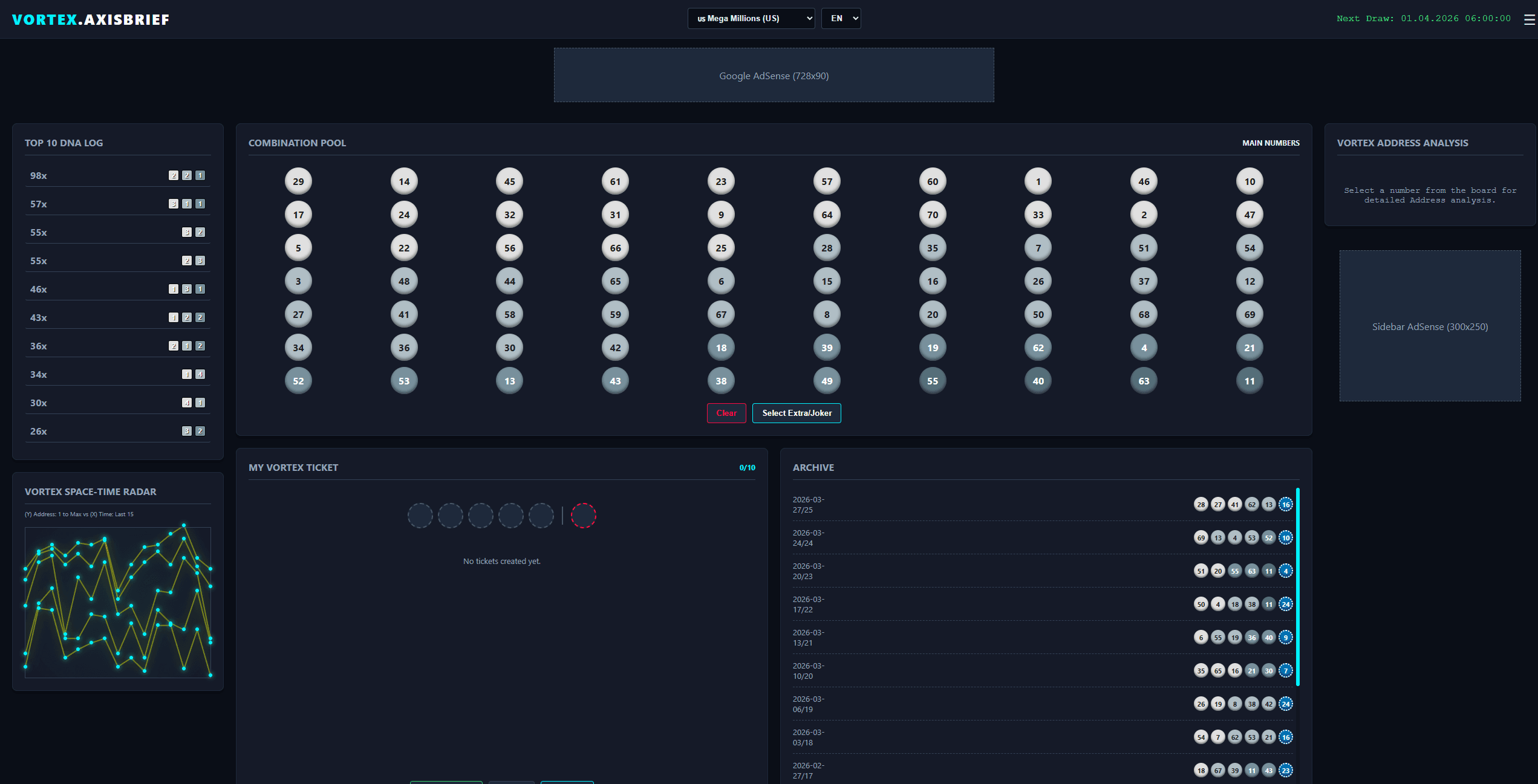
Bold: (Smiling) That’s correct. While we planned to discuss the abstract algorithms, our community pushed us to provide a functional tool they could actually use. Today, the Vortex Terminal is live, supporting a global lineup: EuroMillions, EuroJackpot, Powerball, Mega Millions, and Çılgın Sayısal Loto. We’ve also launched with multi-language support to ensure this “Strategic Analysis Terminal” is accessible to a global audience.
Editor: One thing that stands out immediately is the Color Blind Mode. Why was that a priority for a data tool?
Bold: Because data should be inclusive. Roughly 8.5% of the global population suffers from color vision deficiency. Since our system uses chromatic neighborhoods to explain the Vortex, we didn’t want nearly a tenth of our users to be left in the dark. We’ve designed a specific mode to ensure that the structural DNA analysis is clear to everyone, regardless of visual perception.
Editor: You’ve mentioned that this terminal is designed for speed and “addressing” rather than just standard stats. How should a new user approach it?
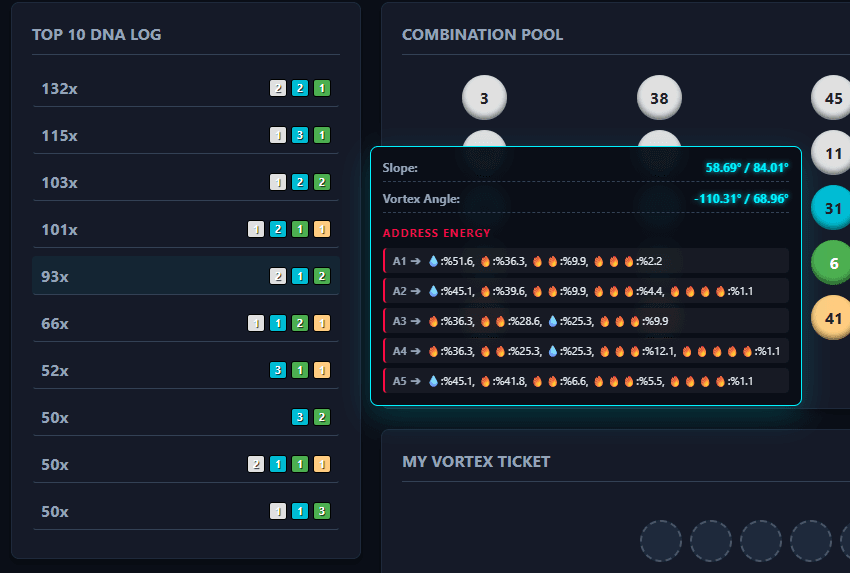
Bold: The terminal treats numbers as residents and their positions as fixed “addresses” within the Vortex. When a user selects a lottery type, the system instantly lists the Top 10 Dominant DNA Patterns for that specific game. We’ve found that these top 10 patterns account for over 50% of outcomes globally—in some systems, it’s as high as 70%. Essentially, one out of every two draws follows one of these primary anatomical pathways.
Editor: Does the user have to follow these DNA models?
Bold: Not at all. Users can choose to lock in a DNA sequence, and the combination pool will intelligently adapt, lighting up only the numbers that fit that specific “chromatic capacity”. But they are also free to build their own strategy. We are data analysts, not lottery operators; we share this data for free because we find the mathematical integrity of these systems fascinating.
Editor: You mentioned that “addresses are fixed, but residents change.” How does that affect strategy?
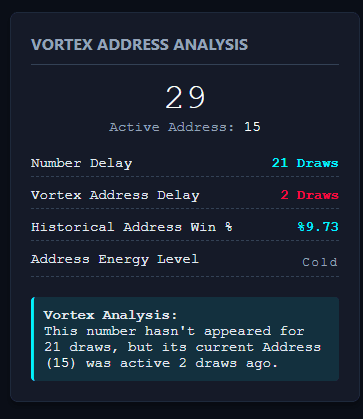
Bold: Traditional stats focus on how long a number has been missing. We focus on the Address Energy. In our system, there are 7 “neighborhoods,” each with minimum and maximum energy limits. A number “earns” its right to live in a neighborhood based on its current energy—it’s born, it learns, it achieves a high rank, and eventually, it recedes. A strategic user should notice that while a number might be “cold,” its current Vortex Address might be very “hot.”
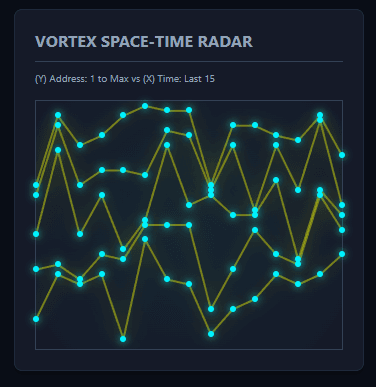
Editor: And what about the X-Y Coordinate System? It looks quite dynamic with those zig-zags.
Bold: That is the Vortex Space-Time Radar. It visualizes the “drift” of addresses over the last 15 draws. You aren’t looking at the numbers themselves, but the expansion and compression of the Vortex field. If you focus on the neon points, you can see which number currently occupies that coordinate. Interestingly, the same DNA pattern rarely repeats back-to-back; the global repeat rate for an identical DNA sequence is only about 3% to 8%.
Editor: One final technical note: I noticed the terminal doesn’t save user tickets after a session is closed.
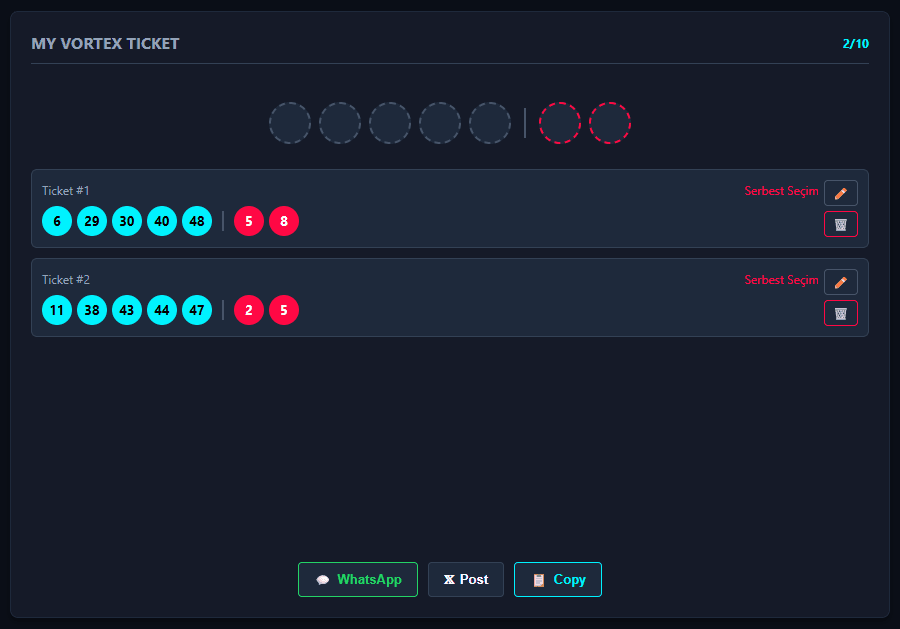
Bold: That was a deliberate privacy decision. We do not store your combinations on our servers. Once you close your browser, the data vanishes. However, we’ve provided integrated sharing tools so users can post their strategies to various platforms or copy them locally if they wish.
Editor: This is a bold step forward in data visualization, Mr. Bold. What’s next for the project?
Bold: We are evaluating whether to introduce “Neighborhood Correlation” analysis—studying how certain addresses “like” to appear together. But I must emphasize: as data analysts, we are not encouraging gambling. We are presenting analytical insights into a system governed by pure mathematics and algorithms. If anyone feels they may have a gambling addiction, we strongly urge them to seek help through the resources listed in the Axis Brief Terms of Service.
Editor: Insightful as always. Thank you, Mr. Bold. We look forward to seeing how the global community interacts with the Vortex.
Bold: The dance with data continues. See you in the next installment.