Deciphering the Matrix: Highway Lanes, City Climates, and Trend Tracking
EDITOR: Welcome back, Mr. Bold. Our inbox has been absolutely flooded since the terminal went live! We are receiving incredible feedback from all over the world. It seems our users aren’t just using the Vortex Terminal; they are practically conversing with it.
BOLD: (Smiling) It’s great to be back. The most exciting part is always when data begins to speak its own language and people actually hear it. The sheer volume of reactions shows we are on exactly the right track.
EDITOR: Absolutely. Especially after we shared the Euro Millions, EuroJackpot and Mega Millions matrices, we started getting very specific questions. I’d like to read you a message from one of our users right here: “When I scan the image from bottom to top (from past to present), I can definitely see those flows and faint channels you mentioned. Especially the visual pathways created by thick-bordered circles that start from the green and orange zones on the bottom right and curve towards the left (blue and gray zones) over time… Sometimes concentrating in certain column groups and then dispersing. It’s impossible not to notice them. Should I play based on these pathways? What should my strategy be?”
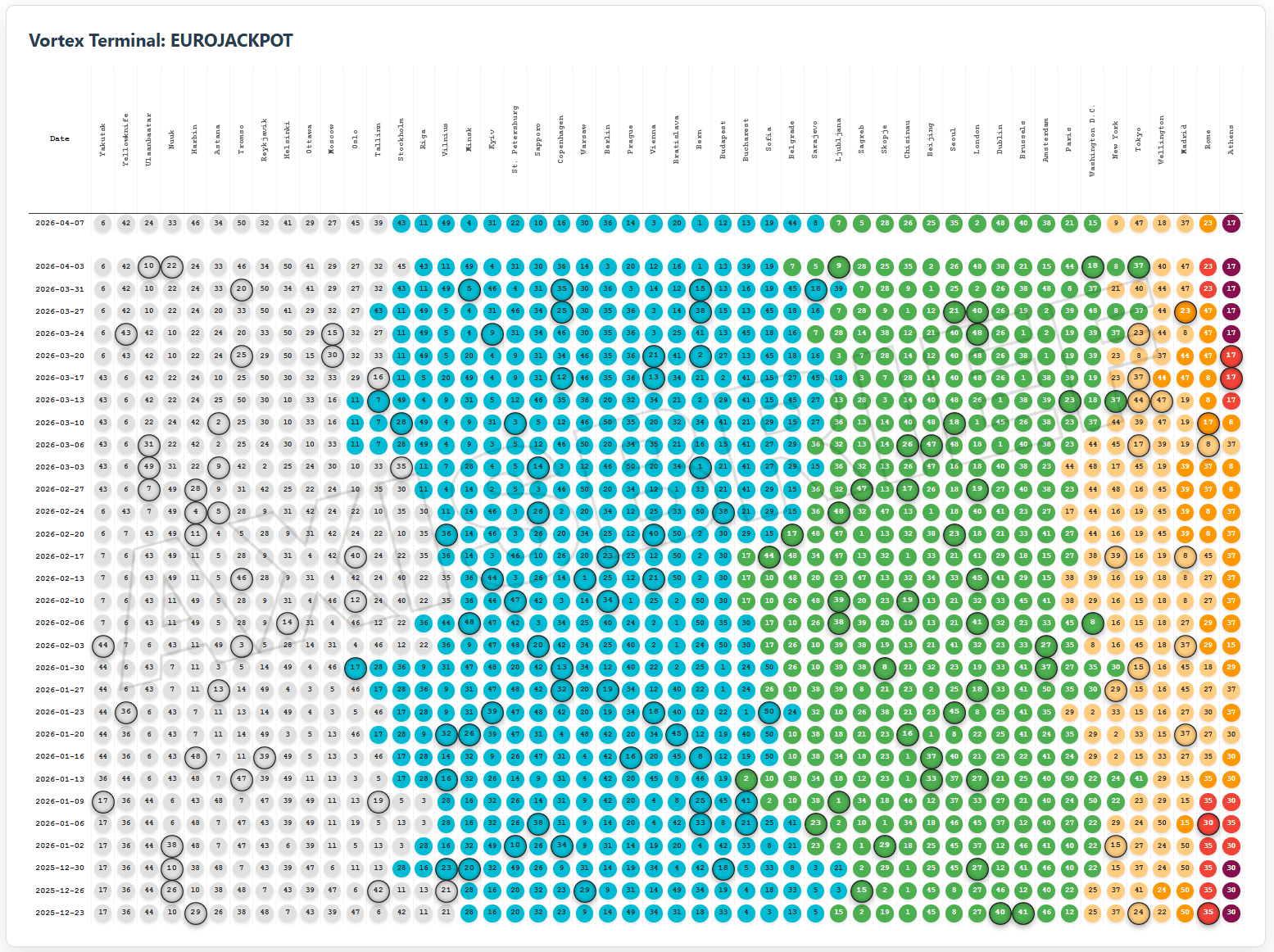
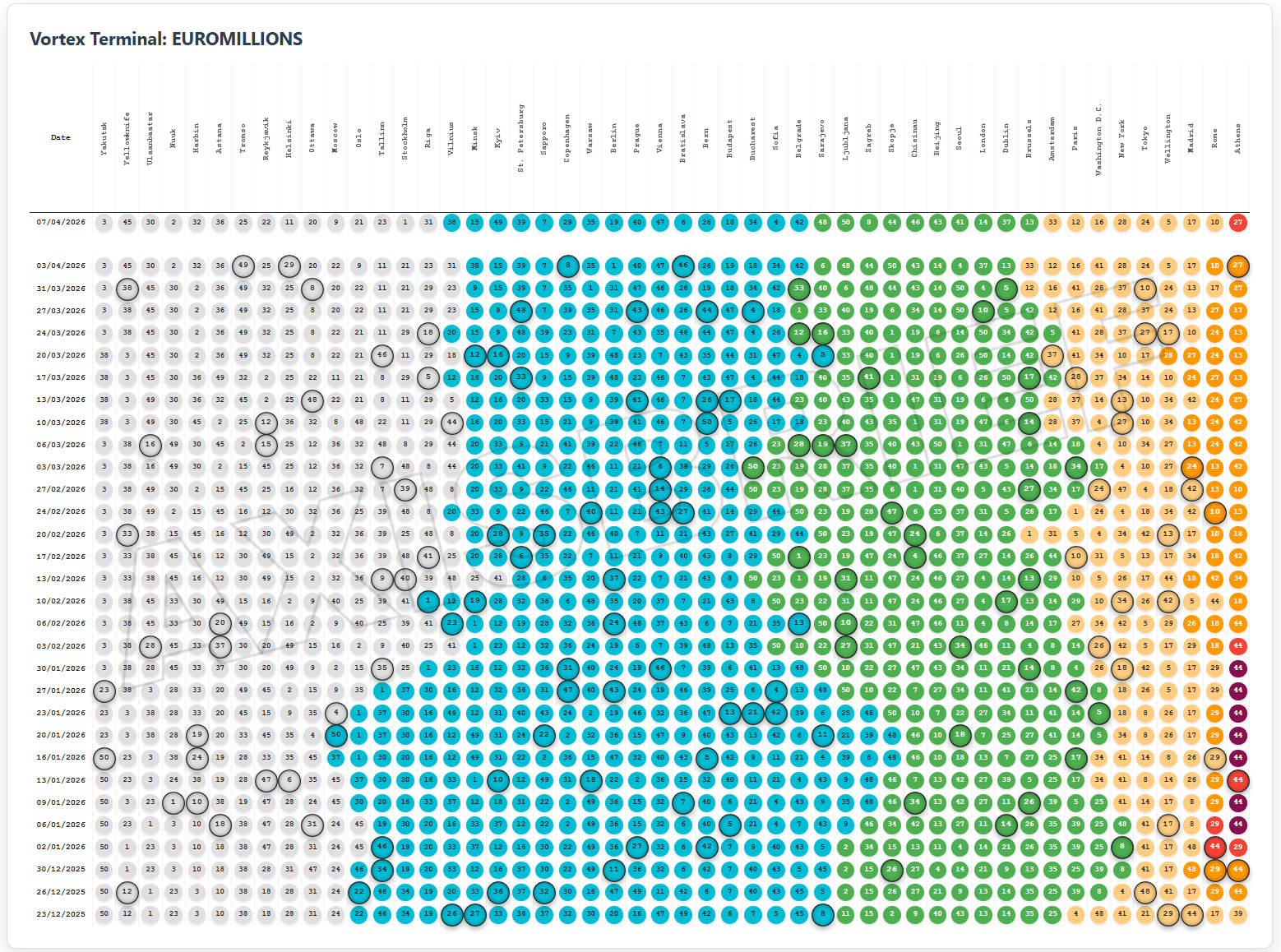
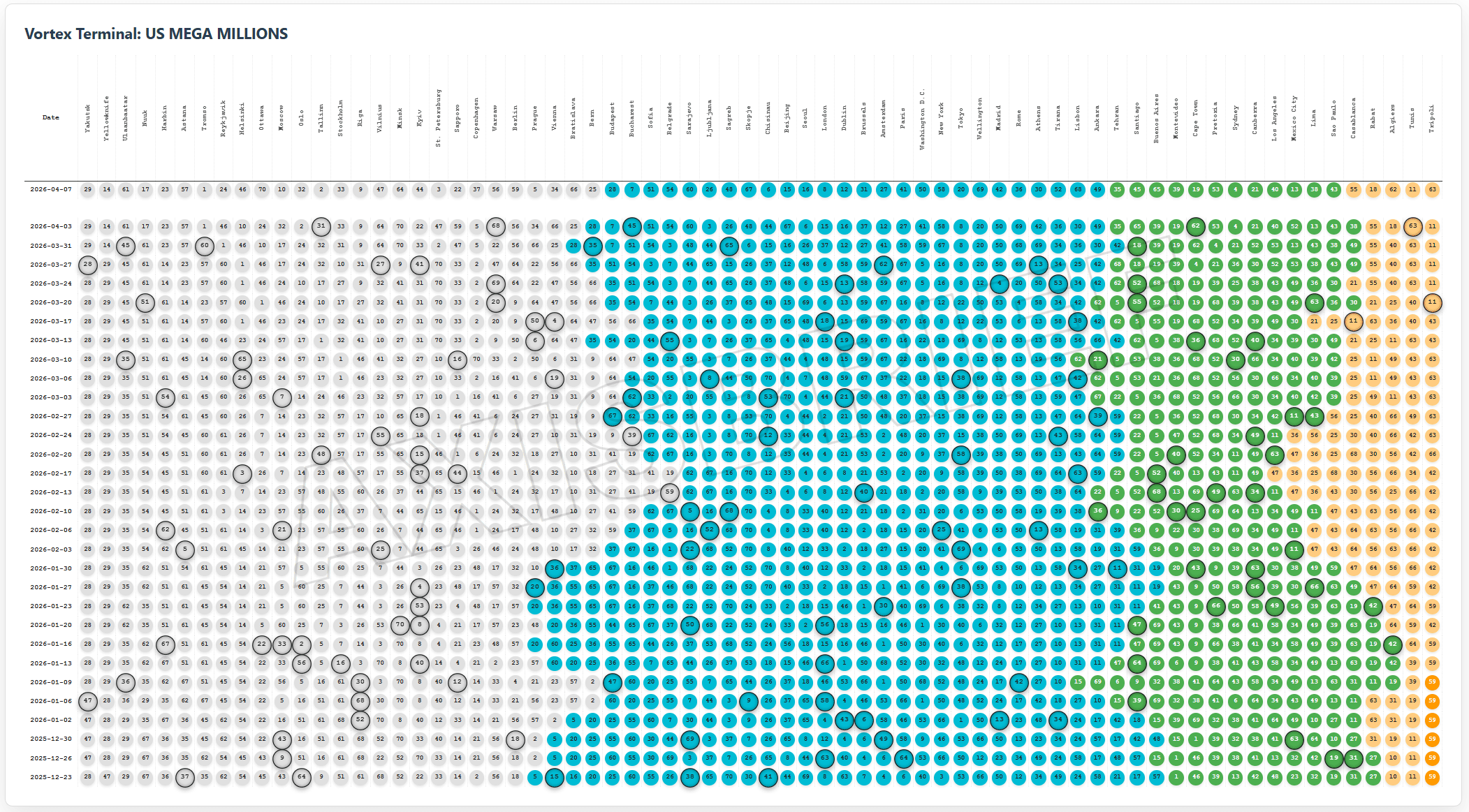
BOLD: A brilliant observation. First off, I must say that the human brain is evolutionarily highly adept at catching cross-patterns and clusters in such matrices. In fact, those flows the user sees represent the acceleration movement of numbers from past draws within their Vortex Addresses (positions). However, right at this point, we need to draw the boundaries of analytics very clearly: Users must never think that these flows are a hidden physical working principle of the lottery machine. There is no rigged machine or flawed physical probability here. No one should fall into that misconception.
EDITOR: What about predicting the future? Isn’t it completely natural for users to ask, “Since there is such a flow in the past, can I predict its future destination?”
BOLD: It is very natural, of course. The human mind is programmed to find patterns and extract actionable results from them. But this is where the unshakable and cold rule of statistics comes into play: The Principle of Independent Events. Every draw is entirely independent of the previous one. Lottery balls do not have a mind, memory, or loyalty; they don’t say, “I came out of this channel last time, let’s not break the route this time.” Just because a number is at the “New York” Vortex address, and that address is in a very “hot” period, does not guarantee that the number will drop from the machine in the next draw.
EDITOR: Then how do we integrate these highways and channels into our strategy?
BOLD: These flow paths they see in the Vortex addresses arranged according to the Fibonacci structure are a map of the past, yes. But they should pay attention; if this were a definitive path, every draw would show continuity in a straight line. Think of it like this: You are on a wide, multi-lane highway. You don’t stay in the same lane for the entire journey, do you? You change lanes according to traffic conditions, your speed, and weather. The Vortex is just like that; as numbers gain frequency, they change lanes (addresses).
Therefore, they need to position the terminal not as a crystal ball, but as a Trend Analysis tool. Let me expand a bit on what I said for the X-Y Space-Time Radar: What we offer is the logic of Trend Following. The Weighted Moving Average (WMA) of Vortex addresses, momentum flows, and frequency transitions serve as a massive filter reflecting heat trends. Instead of picking random numbers or telling the machine to “Quick Pick,” we aim for the user to build a systematic strategy with their own foresight. Judging by the reactions, data science has already entered the world of games of chance. Remember; data is the map of the past that never lies.
EDITOR: There is another detail in the visual that draws a lot of attention: The addresses are indicated not by numbers, but by City Names. Why did you use city names? Is there a special meaning to this?
BOLD: This wonderful idea actually came from a user in our community. We adapted and developed this idea into the Vortex logic. If you notice, on the far left, there are freezing cities like Yakutsk and Nuuk, while as you move to the right, it transitions to warm cities like Miami and Cairo. So, the cities are ranked according to climate, or rather, average temperatures. To materialize the “Heat Trends” metaphor I just mentioned, we gave each Vortex address a city name.
Since the numbers vary in every draw, it is very exhausting for a user to constantly count columns or calculate “I’m currently at the 34th address” while building their own system. Now, no one bothers with counting. Furthermore, this has created a massive community culture. Instead of just writing numbers in the comments and causing confusion, people share their strategies using great jargon, saying, “My favorite today is the energy of Tokyo and Ankara.”
EDITOR: So, when building a strategy, should users predominantly focus only on these hot cities?
BOLD: The majority tends to lean that way, but that would be an incomplete strategy. There is a very fundamental law in financial markets called ‘Mean Reversion’. When the ‘Ghost Towns’ on the left side, namely freezing addresses like Yakutsk or Reykjavik, remain empty for a long time, an incredible potential energy, a ‘Lag Vacuum’, accumulates there. A smart strategist makes sure to add not only the crowded and popular ones to their portfolio, but also the ghost towns that are about to wake up.
EDITOR: How do we recognize a city that is about to wake up, meaning a trend is starting, on the chart?
BOLD: This is where ‘Chromatic Collisions’, or color transitions, come into play. If you look closely at our matrix, the momentum of a number curving horizontally from the blue (cold) zone towards the green (mild) zone is far more valuable than a stagnant number already waiting in the green. A warming trend always generates a stronger signal than a stagnant temperature. Returning to the highway lane-changing metaphor; a vehicle that changes lanes has already accelerated and taken action.
EDITOR: This has truly become a detail that turns the mathematics of the business into flawless analytical art. Thank you for this valuable information, Mr. Bold.
BOLD: It was a great pleasure, as always. See you inside the matrix.
Log in to experience Vortex Terminal.